
 PC
PC  Xbox
Xbox  E-cards
 Solarpunk Review – Building a Better Future, One Floating Island at a Time
Solarpunk offers a refreshing take on the survival genre, replacing combat with farming, automation and sustainable energy systems. Its floating islands, relaxing atmosphere and satisfying progression make it a great choice for players looking to build rather than battle.

Energy. Climate change. Dependence on raw materials. Issues that, just a few years ago, were of interest mainly to experts are now part of our daily lives. Even in gaming. It only takes one crisis to suddenly reveal just how fragile the functioning of modern society can be. Issues of renewable energy, energy self-sufficiency, and sustainability have become an integral part of our lives. And it is precisely at the intersection of technology, ecology, and optimistic visions of the future that the solarpunk movement and genre emerged.
Unlike cyberpunk, which often depicts the future as a bleak place dominated by corporations, solarpunk believes that progress doesn’t have to go against nature. The game Solarpunk from Cyberwave Studio is built precisely on this idea, where instead of fighting monsters or saving the world, you build your own home and travel between floating islands. You grow crops, generate energy from the sun and wind, explore the surroundings, and step by step expand your small farm. It sounds pleasant, even uplifting, doesn’t it? The question, however, is whether the game managed to captivate with anything more than just its appealing vision. And as a graduated environmental geologist, I was eager to find out.

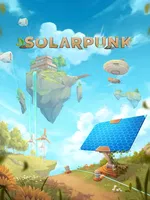
A Completely Laid-back Experience with No Natural Enemies
Thanks to its focus, Solarpunk feels like a quintessential indie game. It wasn’t created in a massive studio with an army of developers, nor is it a game that tries to impress with cinematic cutscenes or epic plot twists. It’s a smaller project built around a single clear concept. It offers an open world composed of several floating islands, between which you gradually move, discovering new resources and expanding your options. Although at first glance it may seem like just another survival game, after a few hours it becomes clear that the developers have taken a slightly different direction than most of the competition.
The beginning, however, feels familiar. You gather branches, stones, and other basic materials. You craft your first tools, build workbenches, and try to secure food and drinking water (with watermelon flavour). The game gently guides you in the right direction at first, but relatively quickly leaves you to fend for yourself. Little by little, you build a farm, grow crops, and unlock new technologies that make your daily tasks easier. Instead of endless mining and reckless industrial expansion, however, Solarpunk emphasizes sustainable management. You do cut down trees, but you also plant them back. You obtain energy from sources that don’t leave a trail of destruction in their wake. And this is where I noticed the biggest departure from its genre cousins.

Who Will Love This Game, and What Other Titles Does It Remind You Of?
While many survival games rely on a constant sense of danger, Solarpunk takes the opposite approach. You won’t find aggressive enemies, base raids, or battles for survival here. It’s much closer to the peaceful atmosphere of Minecraft in a more creative spirit, the building freedom of Raft, or the farming tranquility of Stardew Valley. At the same time, however, it mixes in its own ideas in the form of energy grids, automation, and an ecological approach to base development. At certain moments, it even brings to mind Satisfactory, though instead of massive factories and smoking chimneys, here you strive to create a self-sustaining ecosystem that functions in harmony with its surroundings. In our video review, we even compare it to Subnautica!
This also makes it pretty clear who the game is intended for. If you expect nonstop action, adrenaline, and a race against time from the survival genre, Solarpunk probably won’t appeal to you. On the contrary, players who enjoy building, planning, and slowly improving their little virtual kingdom will get the most out of it. It’s a game for people who can spend an hour tweaking their farm, searching for a more efficient energy source, or designing a cozy house with a view of the clouds. Solarpunk doesn’t try to rush the player but instead gives them freedom.
Because the term “cozy” often evokes simpler and less demanding gameplay these days, Solarpunk proves that a slower pace doesn’t have to mean a shallow experience. Instead of combat, it creates tension through resource management, weather, and energy systems, and whether this form of planning relaxes or frustrates you depends largely on your personality.

Among the Clouds and Greenery
One of Solarpunk’s biggest draws is undoubtedly its world. Flying islands shrouded in vegetation create a pleasant backdrop that perfectly complements the game’s laid-back pace. At first, I looked forward to exploring new locations and searching for the resources needed to progress. However, the more time I spent in the game, the more it became clear that the individual islands primarily function as reservoirs of new materials.
After thoroughly exploring them, there often aren’t many reasons to return. While the world feels inviting and visually appealing, it lacks the surprises, interesting locations, or events that would sustain a long-term sense of discovery. Solarpunk thus offers a pleasant environment to live in, but not always a sufficiently interesting place to explore.

If you’re looking for a story, dialogue, or more distinctive characters, you’re in the wrong place. Solarpunk practically abandons storytelling entirely and focuses all its attention on the actual exploration, building, farming, and automation. Character creation follows the same—and thus practically nonexistent—spirit. You choose from a few options like body type, hair type and so on, and that is it.

A Peaceful Life Without a Sword in Hand
If there’s one aspect on which Solarpunk stands or falls, it’s its laid-back gameplay. From the very first minutes, it’s clear that the developers have opted for a more relaxed pace and building a self-sufficient life rather than a constant struggle for survival. You start by gathering resources, crafting your first tools, and securing food and water. After a brief introduction, the game leaves you to your own curiosity, and that’s when all its systems really kick into gear.
The core of the gameplay is the step-by-step development of your base. You grow crops, unlock new technologies, and build an energy infrastructure powered by the sun, wind, or water. Solar panels, batteries, and automatic irrigation don’t feel like add-ons, but rather a natural part of your progress. The more effectively you can connect the individual systems, the greater the rewards the game offers.

However, not everything works flawlessly. As the hours go by, a certain repetitiveness begins to set in. Discovering new islands initially brings a sense of adventure, but later often turns into the routine collection of yet another type of ore or plant needed to unlock the next part of the tech tree. Furthermore, some processes are unnecessarily slowed down by waiting for items to be crafted, crops to grow, or raw materials to be processed. While this is a pleasant way to relax in the early hours, I later found myself repeatedly just waiting for the next step to finish.
Despite this, I enjoyed the gameplay more than I originally expected. Solarpunk may not be revolutionary, and in many mechanics it follows the well-trodden paths of the survival genre, but the way it combines them into a single eco-friendly whole works surprisingly well. If you embrace its leisurely pace and don’t try to play it like a classic action-packed survival game, it will reward you with a very enjoyable experience.

An Unexpectedly Wide Range of Building Options and Changing Weather
The controls themselves are simple and intuitive, from opening the inventory and using items to building just about anything. You can choose what to build and where, as well as how to orient the planting beds or where to place solar panels. When building large structures or entire complexes, it’s also nice to see that the developers put in the effort to provide a wide variety of building blocks so that everything can be customized to your preferences.
As for research, it’s just as intuitive as the controls, and the game guides you toward what you’ll need and how to achieve it. Amid all this, don’t forget about the changing weather, which is the game’s alpha and omega; besides running out of energy or resources, there’s also the possibility that, for example, lightning will strike and end your efforts. Those who don’t believe it can grab a pickaxe and climb the highest mountain in the area during a storm. And maybe they’ll find luck in misfortune—or vice versa.

The Airship as a Symbol of Freedom and the Game's Highlight
One of the most enjoyable moments in the entire game is when you finally take to the skies, breaking free from the confines of the introductory island. But you have to earn the airship first. You’ll assemble it from the wreckage of a crashed machine and the first advanced components you craft as you progress through the game. From that moment on, the path to other islands, new resources, and technologies opens up before you. It’s not just a means of transportation, but one of the main pillars of progress, because without regular expeditions, you wouldn’t be able to move forward.

The flying itself fits perfectly into the Solarpunk philosophy. Forget about fast travel or automatic movement between points on the map. Traveling between islands requires a bit of patience and a dose of caution when landing. Sometimes I felt like the game was deliberately slowing down the pace so that the player would be more aware of the distances between individual locations. For some, this might be an unnecessary delay, but to me, this approach made sense. Here, the journey becomes part of the experience, not just a necessary break between two tasks. And, of course, the airship is one of the most eco-friendly modes of air travel.
The airship also nicely reinforces the sense of steady growth. With each upgrade, you venture further from your home island, discovering new types of crops, animals, and rarer resources. Although the game later begins to run into the problem of repetitive activities, the system of exploration via the airship itself is one of its most successful elements. It adds a certain sense of adventure to the world while reinforcing the impression that you are building your small, eco-friendly civilization step by step through your own efforts.

A Pleasant Setting That Doesn't Try to Impress
Visually, Solarpunk perfectly captures what it sets out to be. Instead of chasing photorealism, it opts for a simpler, colorful style that enhances the peaceful atmosphere of the floating islands. Lush vegetation, open horizons, and handcrafted cottages create pleasant scenery where it’s easy to switch off for a moment and simply enjoy the view of the world below. At the same time, however, it must be admitted that the game doesn’t take many visual risks. Some environments start to feel similar after a while, and even the animals and other objects don’t seem as lively as a game with this focus deserves. Fortunately, the technical side is in very good shape. While playing, I only encountered minor bugs and occasional glitches during interactions, which certainly didn’t spoil the experience in any major way.
The audio takes a similar approach. The soundtrack stays in the background and doesn’t try to draw attention to itself. Instead of memorable melodies, it creates a subtle musical backdrop that complements the sound of the wind, rain, and other ambient sounds. It works exactly as it should, but at the same time, it’s one of the aspects you probably won’t remember for long after finishing the game. Which, in the end, didn’t bother me—quite the opposite.

Verdict: 8/10
Simply put, Solarpunk won’t be everyone’s cup of tea, as the developers themselves acknowledge, offering a brief overview of who the game is intended for. Preventing a mispurchase is simply better than dealing with negative reviews from dissatisfied players. The game doesn’t offer epic battles, a cinematic story, or an endless world full of attractions on every island. Instead, it relies on patient planning and the joy of gradually building something of your own. And that is precisely where its greatest strength lies. When all the systems come together into a single functioning whole—the farm thrives, the batteries charge, the machines run, and the airship heads off on another adventure—the game delivers a very satisfying sense of accomplishment.
Yes, the world could be livelier, exploration more varied, and repetitive tasks start to feel more tedious over time. Despite this, I often found myself saying the familiar “I’ll just finish one more thing and then I’m done,” followed by another hour of building, farming, or upgrading the base. For a small indie production, this is a surprisingly expansive project with plenty of options, a charming philosophy, and gameplay that can keep you engrossed for dozens of hours. If you’re looking for a peaceful, non-violent survival game that lets you build your own piece of eco-utopia among the clouds, Solarpunk is one of the most exceptional projects of recent years. A rating of 8/10 is more than well-deserved in this case.


